

Two days, 10 stops, no day overloaded — the MEVAYA planner splits Madrid so each day stays walkable and nothing on the route is closed when you arrive.
- Suggested duration
- Two full days, about 09:00–18:00
- Major stops
- 10 across both days, plus lunch each day
- Getting around
- About 6.8 km on foot over two days, 2.5 km by public transport
- Planned for
- Wednesday and Thursday
- Suits
- A first visit that wants more than Madrid's headline sights
Dates already set? Plan your 2 days in Madrid →
In this article · 6 min read
The route
Day 1
09:00Puerta de Alcalá · about 17 min
Walk · 0.9 km · about 18 min
09:35Retiro Park · about 104 min
11:19Lunch break · about 60 min
Walk · 0.9 km · about 18 min
12:37Museo del Prado · about 173 min
Walk · 1.3 km · about 23 min
15:53Puerta del Sol · about 23 min
Walk · 1.0 km · about 19 min
16:35Plaza de Oriente & Sabatini Gardens · about 40 min
Walk · 0.5 km · about 12 min
17:27Almudena Cathedral · about 33 min
Day 2
09:00Plaza Mayor · about 33 min
Walk · 0.8 km · about 17 min
10:00Royal Palace of Madrid · about 127 min
Public transport (planner estimate) · 2.5 km · about 19 min
12:26Palacio de Cibeles viewpoint · about 49 min
13:15Lunch break · about 60 min
Walk · 1.5 km · about 25 min
14:40Museo Reina Sofía · about 138 min
Three great museums, and dinner at ten. Madrid keeps late hours: lunch at two, dinner at half past nine or later, and the streets busiest around midnight. Its daytime is ordered around the Paseo del Prado, three world-class museums within ten minutes' walk of each other, with the Royal Palace on the far side of the old centre.
Two days is enough to see Madrid without racing it. This plan comes straight from the MEVAYA planner: 10 stops across a Wednesday and a Thursday, with Museo del Prado, Retiro Park and Royal Palace of Madrid among the fixed points and the rest chosen and ordered by the planner.
Day 1, stop by stop
09:00–09:17 — Puerta de Alcalá. Carlos III's neoclassical gate of 1778, now standing alone in the middle of a roundabout at the Retiro's north-west corner. Lit at night, and a natural photo stop on the way into the park. It is a public open-air space with no ticket and no closing day.
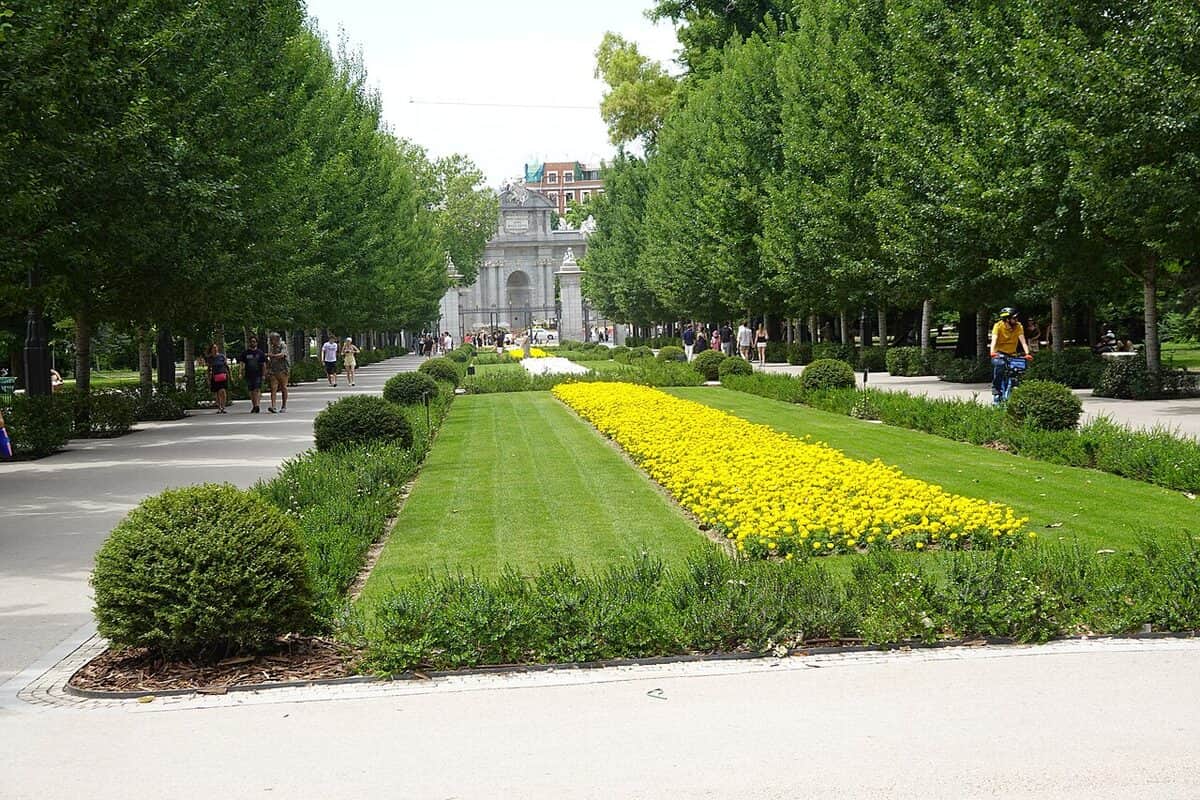
09:35–11:19 — Retiro Park. The former royal park behind the Prado: a boating lake under a colonnaded monument, formal avenues and shaded lawns where Madrid spends its Sunday. Its landscape, with the Paseo del Prado, is a UNESCO World Heritage site. Verified opening hours: April to September daily 06:00–00:00; October to March daily 06:00–22:00. The city closes El Retiro and other parks during high-wind and heat alerts.
11:19–12:19 — Lunch. The planner reserves time to eat right after Retiro Park, so the afternoon continues from where the morning ended instead of detouring for food.
12:37–15:30 — Museo del Prado. Velázquez's Las Meninas, Goya's Black Paintings and Bosch's Garden of Earthly Delights under one roof, in one of the densest collections of European painting anywhere. Pick three rooms and do them properly; trying to see it all is how people leave having seen nothing. Verified opening hours: Monday to Saturday 10:00–20:00; Sundays and public holidays 10:00–19:00. Free admission in the last two hours (18:00–20:00 and 17:00–19:00). Closed on 1 January, 1 May and 25 December; 10:00–14:00 on 6 January, 24 and 31 December. A timed slot is needed, also for free entry. Book ahead: this stop needs a reservation or a timed ticket.
15:53–16:16 — Puerta del Sol. The square at the centre of Spain, literally: the Kilómetro Cero plaque in the pavement is where national road distances are measured from. The clock on the old post office rings in New Year for the whole country. It is a public open-air space with no ticket and no closing day.
16:35–17:15 — Plaza de Oriente & Sabatini Gardens. The formal square between the Royal Palace and the Teatro Real, lined with statues of Spanish kings that were meant for the palace roof, with the clipped Sabatini Gardens running along the palace's north side. A calm place to sit between the palace and the opera. It is a public open-air space with no ticket and no closing day.
17:27–18:00 — Almudena Cathedral. Facing the Royal Palace across the square, a cathedral begun in 1883 and consecrated only in 1993, which is why the ceiling is painted in bright modern colours. Entry to the church is free; the dome and museum are ticketed. Verified opening hours: Cathedral daily 10:00–20:30. Entry to the church is free; the dome and museum are ticketed with their own hours. Visits pause during Mass.
Day 2, stop by stop
09:00–09:33 — Plaza Mayor. An enclosed 17th-century square of red facades and 237 balconies, used over the centuries for bullfights, coronations and the Inquisition's trials. Walk through it; eat elsewhere. It is a public open-air space with no ticket and no closing day.
10:00–12:07 — Royal Palace of Madrid. With more than three thousand rooms, the largest royal palace in Western Europe, still used for state ceremonies. The visit covers the throne room, the porcelain room and a Stradivarius quartet; the armoury across the courtyard is included and often skipped. Verified opening hours: October to March Monday to Saturday 10:00–18:00; April to September Monday to Saturday 10:00–19:00; Sundays 10:00–16:00 all year. Last entry one hour before closing. Closed on 1 and 6 January, 1 May and 25 December; early closing on 24 and 31 December. Can close at short notice for official ceremonies. Free for EU residents Monday to Thursday in the last two hours. Book ahead: this stop needs a reservation or a timed ticket.
12:26–13:15 — Palacio de Cibeles viewpoint. The wedding-cake former post office, now City Hall, with a cultural centre inside and a viewing gallery up in the tower over the Cibeles fountain and Calle de Alcalá. Entry slots are timed and the gallery is small. Verified opening hours: Tuesday to Sunday 10:30–14:00 and 16:00–19:30, entry about every 30 minutes (last admission 13:30 and 19:00). Closed on Mondays, 1 and 6 January, 1 May, 24, 25 and 31 December. Can close without notice for safety or bad weather.
13:15–14:15 — Lunch. The planner reserves time to eat right after Palacio de Cibeles viewpoint, so the afternoon continues from where the morning ended instead of detouring for food.
14:40–16:58 — Museo Reina Sofía. Spain's national museum of modern art, in a former hospital with glass lift towers bolted to the facade. Picasso's Guernica is on the second floor, in a room that is crowded at every hour; the Dalí and Miró rooms nearby are not. Verified opening hours: Monday and Wednesday to Saturday 10:00–21:00 (free 19:00–21:00); Sunday 10:00–14:30 (free 12:30–14:30). Closed on Tuesdays, 1 and 6 January, 1 May, 15 May, 9 November, and 24, 25 and 31 December.
Why this split works
Day 1 uses the early morning for Puerta de Alcalá — an open-air sight with no opening hours, which is the best use of the time before ticketed venues open.
Day 1 reaches Museo del Prado at 12:37, after it opens at 10:00, so there is no waiting at the door.
Day 2 uses the early morning for Plaza Mayor — an open-air sight with no opening hours, which is the best use of the time before ticketed venues open.
Day 2 reaches Royal Palace of Madrid at 09:50 and waits 10 minutes for it to open at 10:00; the wait is built into the plan.
Realistic timing
Times come from the planner's visit-length model: every stop starts from its typical duration, is adjusted for a couple at a balanced pace, and every walk gets a small buffer. The day runs from 09:00 to 18:00.
The longest stops are Museo Reina Sofía (138 minutes) and Royal Palace of Madrid (127 minutes). If a stop takes longer than planned, the planner in the app reschedules the rest of the day around it.
To keep the day realistic, the planner left out 4 further candidates rather than squeezing them in at a run.
What to change if…
It rains. Puerta de Alcalá, Retiro Park and Puerta del Sol are largely outdoors. Rain-safe alternatives in MEVAYA's Madrid data include Royal Palace of Madrid and Museo Reina Sofía.
You are travelling with children. Switch the party to "family" in the planner and it keeps walks shorter (it caps a single walking leg at about 1.1 km) and favours family-friendly stops such as Madrid Río.
You start late. Planned with an 11:00 start, the planner drops Puerta de Alcalá, Retiro Park, Puerta del Sol, Plaza de Oriente & Sabatini Gardens and Almudena Cathedral and keeps the rest of this route.
Mobility is limited. Retiro Park: Main avenues are wide and level; some side paths are gravel. Museo del Prado: Fully wheelchair accessible via the Jerónimos building entrance, with lifts to every floor. Choose "step-free" in the planner and it filters out stops known to be inaccessible.
Before you go
Built by the MEVAYA planner from MEVAYA's curated Madrid data. Opening hours were checked against official and independent sources in October 2026; the route, times and durations are the planner's own output, not estimates written by hand.
This route, rebuilt for your day
The planner reworks it for your date, start time and pace, with the same checked opening hours.
Quick Start is free and needs no account. A personalised plan needs a City Pass.
Quick questions
Is two days enough for Madrid?
Two days covers 10 of the 25 curated sights in MEVAYA's Madrid data at a balanced pace — the classic centre plus a second, quieter layer of the city.
Which days is this plan built for?
It was planned for a Wednesday and Thursday. The planner checks every stop's closing days, so other days may produce a different route.
Do I need to book anything?
Yes: Museo del Prado and Royal Palace of Madrid.
Want to see what fits your day in Madrid?
Plan your 2 days in MadridFor the rest of your trip
- Madrid city guide
- Madrid in One Day: A Realistic Itinerary · 4 min read
- What's Open in Madrid on a Tuesday? · 4 min read
- Berlin in One Day: A Realistic Itinerary · 8 min read