
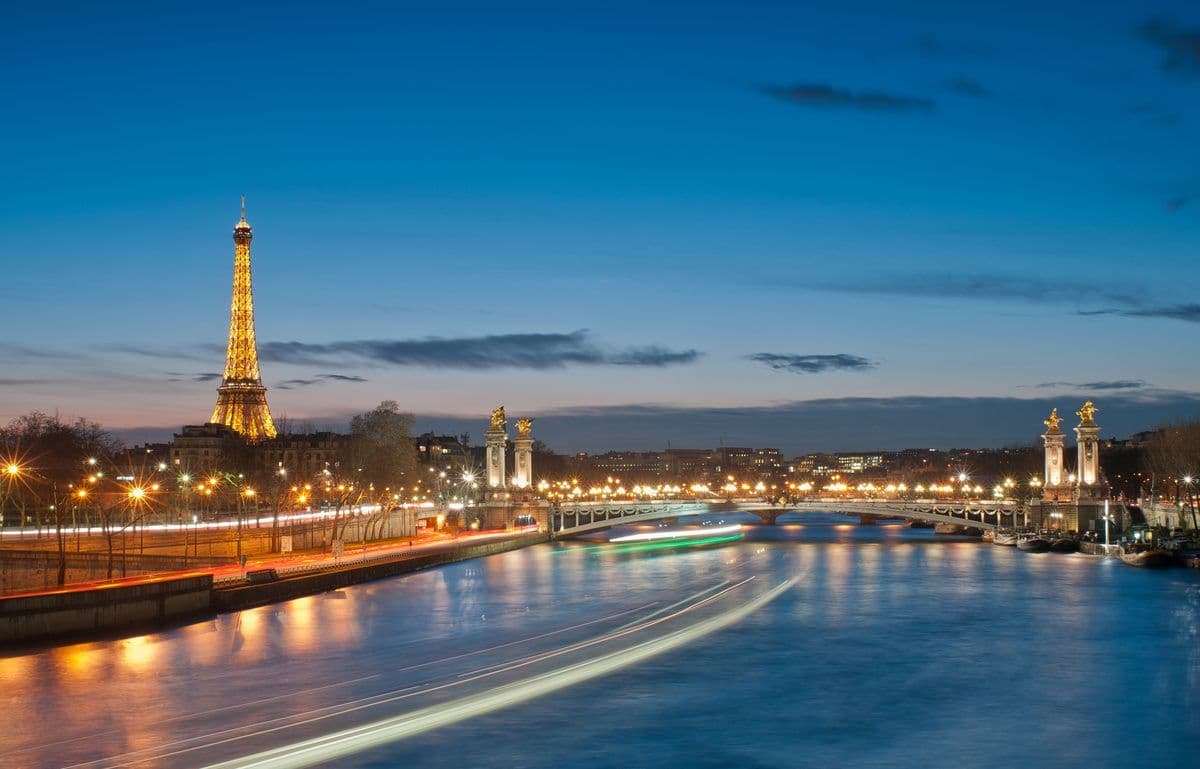
Two days, 10 stops, no day overloaded — the MEVAYA planner splits Paris so each day stays walkable and nothing on the route is closed when you arrive.
- Suggested duration
- Two full days, about 09:00–17:52
- Major stops
- 10 across both days, plus lunch each day
- Getting around
- About 2.1 km on foot over two days, 19.1 km by public transport
- Planned for
- Wednesday and Thursday
- Suits
- A first visit that wants more than Paris's headline sights
Day 1
09:00Trocadéro esplanade · about 40 min
Walk · 0.7 km · about 16 min
09:56Eiffel Tower · about 121 min
Public transport (planner estimate) · 2.2 km · about 18 min
12:15Arc de Triomphe · about 52 min
13:07Lunch break · about 60 min
Public transport (planner estimate) · 4.9 km · about 25 min
14:32Montmartre & Sacré-Cœur · about 107 min
Public transport (planner estimate) · 4.8 km · about 25 min
16:44Notre-Dame & Île de la Cité · about 68 min
Day 2
09:00Sainte-Chapelle · about 58 min
Walk · 0.8 km · about 16 min
10:14Musée de Cluny · about 81 min
Walk · 0.6 km · about 13 min
11:48Panthéon · about 67 min
12:55Lunch break · about 60 min
Public transport (planner estimate) · 4.0 km · about 23 min
14:18Canal Saint-Martin · about 69 min
Public transport (planner estimate) · 3.2 km · about 21 min
15:48Palais Garnier · about 67 min
Build this around your own pace
This is one realistic version. The planner rebuilds it around your start time, interests, pace and the day of the week — with the same verified Paris data.
Plan your Paris dayGrand on the boulevards, quiet one street back. The monuments are exactly as advertised; the surprise is how fast the crowds thin when you step off the axis. Paris rewards a day that alternates — one ticketed landmark, one arrondissement to wander.
Two days is enough to see Paris without racing it. This plan comes straight from the MEVAYA planner: 10 stops across a Wednesday and a Thursday, with Trocadéro esplanade, Eiffel Tower and Arc de Triomphe among the fixed points and the rest chosen and ordered by the planner.
Day 1, stop by stop
09:00–09:40 — Trocadéro esplanade. The terrace across the river that gives you the Eiffel Tower head-on, whole, with nothing in the way. Free, always open, and the reason every good photograph of the tower is taken from here rather than underneath it. It is a public open-air space with no ticket and no closing day.
09:56–11:57 — Eiffel Tower. Second floor is the one worth having — the view actually frames the city, where the summit mostly shows you haze. Stairs to level two are cheaper, quicker and far less queued than the lifts. Verified opening hours: Daily 09:30–23:45 (last ascent 22:45). Non-EU visitor pricing may rise in 2026 per new heritage funding rules. Book ahead: this stop needs a reservation or a timed ticket.
12:15–13:07 — Arc de Triomphe. Napoleon’s arch over the world’s most intimidating roundabout. The rooftop is a paid, separate ticket and one of the best views in Paris. Use the underpass to reach it — crossing the traffic on foot is not a thing you do. Verified opening hours: Daily roughly 10:00–23:00 (seasonal, shorter in winter).
13:07–14:07 — Lunch. The planner reserves time to eat right after Arc de Triomphe, so the afternoon continues from where the morning ended instead of detouring for food.
14:32–16:19 — Montmartre & Sacré-Cœur. The hill village that Paris grew around, with the white basilica on top and a free view over the whole city from its steps. The lanes behind the basilica are where the neighbourhood actually is. Verified opening hours: Basilica free entry daily 06:30–22:30; the surrounding Montmartre hill and streets are always open. Dome climb is a separate paid ticket with its own shorter hours.
16:44–17:52 — Notre-Dame & Île de la Cité. Reopened after the fire, and free to enter — but with timed slots that are released a couple of days ahead and go almost immediately. The exterior, the island and the riverbanks around it cost nothing and need no booking. Verified opening hours: Daily roughly 07:45–18:45 (varies by source, confirm before visiting). Reopened 7 December 2024 after fire restoration. Access can still be affected by ongoing finishing works and special services.
Day 2, stop by stop
09:00–09:58 — Sainte-Chapelle. Fifteen metres of 13th-century stained glass on all sides, and the single most astonishing interior in Paris. Small, so it fills fast — and worth timing for a bright day, because the whole point is light. Verified opening hours: Daily roughly 09:00–17:00 (seasonal, extended in summer). Book ahead: this stop needs a reservation or a timed ticket.
10:14–11:35 — Musée de Cluny. Medieval Paris built into a Roman bathhouse, with The Lady and the Unicorn tapestries as the centrepiece. Recently reworked, and still overlooked by nearly everyone walking past it to the Latin Quarter. Verified opening hours: Tue–Sun 09:30–18:15; closed Monday.
11:48–12:55 — Panthéon. A neoclassical mausoleum holding Voltaire, Rousseau, Marie Curie and Josephine Baker, with Foucault’s pendulum swinging under the dome. The colonnade upstairs opens in the warmer months and is rarely queued. Verified opening hours: Daily 10:00–18:00 (Oct–Mar) or 10:00–18:30 (Apr–Sep); last access 45 min before closing. Closed 1 Jan, 1 May, 25 Dec. Opens at 12:00 on the first Monday of the month.
12:55–13:55 — Lunch. The planner reserves time to eat right after Panthéon, so the afternoon continues from where the morning ended instead of detouring for food.
14:18–15:27 — Canal Saint-Martin. Iron footbridges, plane trees and locks, with young Paris sitting on the quaysides drinking supermarket wine on any warm evening. No monument, no ticket, and one of the most pleasant hours in the city. It is a public open-air space with no ticket and no closing day.
15:48–16:55 — Palais Garnier. The opera house that inspired the Phantom — a grand staircase built for being seen on, and a ceiling painted by Chagall. Self-guided visits run through the day when there is no rehearsal. Verified opening hours: Daily roughly 10:00–17:00 for self-guided visits (closed during matinee performances).
Why this split works
It uses the early morning for Trocadéro esplanade — an open-air sight with no opening hours, which is the best use of the time before ticketed venues open.
It reaches Arc de Triomphe at 12:15, after it opens at 10:00, so there is no waiting at the door.
It reaches Musée de Cluny at 10:14, after it opens at 09:30, so there is no waiting at the door.
The day covers about 1.3 km on foot and 2 public-transport hops (about 7.2 km), used only where walking would cost more time than it saves.
Realistic timing
Times come from the planner's visit-length model: every stop starts from its typical duration, is adjusted for a couple at a balanced pace, and every walk gets a small buffer. The day runs from 09:00 to 17:52.
The longest stops are Musée de Cluny (81 minutes) and Canal Saint-Martin (69 minutes). If a stop takes longer than planned, the planner in the app reschedules the rest of the day around it.
To keep the day realistic, the planner left out 3 further candidates rather than squeezing them in at a run.
What to change if…
It rains. Trocadéro esplanade, Arc de Triomphe and Montmartre & Sacré-Cœur are largely outdoors. Rain-safe alternatives in MEVAYA's Paris data include Panthéon and Louvre.
You are travelling with children. Switch the party to "family" in the planner and it keeps walks shorter (it caps a single walking leg at about 1.1 km) and favours family-friendly stops such as Jardin du Luxembourg and Jardin des Tuileries.
You start late. Planned with an 11:00 start, the planner drops Montmartre & Sacré-Cœur and Notre-Dame & Île de la Cité and keeps the rest of this route.
Mobility is limited. Eiffel Tower: Wheelchair accessible up to the 2nd floor via elevator. Reaching the 3rd floor/summit requires climbing 18 steps to a second elevator, so it is not step-free. Arc de Triomphe: NOT wheelchair accessible — entry is by stairs only. Choose "step-free" in the planner and it filters out stops known to be inaccessible.
Before you go
Built by the MEVAYA planner from MEVAYA's curated Paris data. Opening hours were checked against official and independent sources in September 2026; the route, times and durations are the planner's own output, not estimates written by hand.
Quick questions
Is two days enough for Paris?
Two days covers 10 of the 33 curated sights in MEVAYA's Paris data at a balanced pace — the classic centre plus a second, quieter layer of the city.
Which days is this plan built for?
It was planned for a Wednesday and Thursday. The planner checks every stop's closing days, so other days may produce a different route.
Do I need to book anything?
Yes: Eiffel Tower and Sainte-Chapelle.