
Munich's old town fits into a morning. The rest of the city is museums, parks and beer gardens spread out in every direction - and in 2026, a few well-known sights are closed or only half open.
- Closed or half-open in 2026
- Olympiaturm closed; Deutsches Museum half open; Neue Pinakothek closed (key works shown in the Alte Pinakothek)
- Best free view now
- Alter Peter tower, right behind Marienplatz (about 300 steps, no lift)
- Sunday tip
- The Pinakotheken cost €1 on Sundays; most shops and the Viktualienmarkt are closed
- Closed on Mondays
- Alte Pinakothek, Pinakothek der Moderne, NS-Dokumentationszentrum
Many of the classic things to do in Munich fit into a single morning: Marienplatz, the Frauenkirche, the Viktualienmarkt and a couple of churches, all within ten minutes' walk. What makes the city worth more than a day lies outside that core - a cluster of world-class museums, one of the largest city parks in Europe, the 1972 Olympic site, a summer palace, and a river people actually swim in.
There's one more thing to know before planning: in 2026, a few of Munich's best-known sights are closed or only partly open. That's not a reason to go elsewhere, but it does change which sights make sense, and several older lists haven't caught up.
Everything below comes from MEVAYA's curated Munich data, the same stops, visit durations and closure notes the planner uses. A realistic day holds 3 to 4 substantial stops. In summer, one of them should probably be a beer garden; that's less indulgence than local custom.
What's closed or half-open in 2026
Olympiaturm. The 291-metre tower in the Olympiapark has been fully closed for renovation since June 2024; reopening is expected in early 2027. The free Olympiaberg hill next to it still gives a view to the Alps on a clear day.
Deutsches Museum. Under a major renovation: only one half of the museum is currently open, and the second half is expected by 2028. It's still enormous, and still worth going, but some classic exhibits aren't on display.
Neue Pinakothek. Closed for renovation until around 2030. Its key works, from van Gogh to Spitzweg, are shown in the Alte Pinakothek in the meantime.
Nymphenburg Palace. Open, but in 2026 the fountain in the Great Parterre is out of service and the Lackkabinett is closed until roughly autumn 2026.
The Altstadt: an easy morning on foot
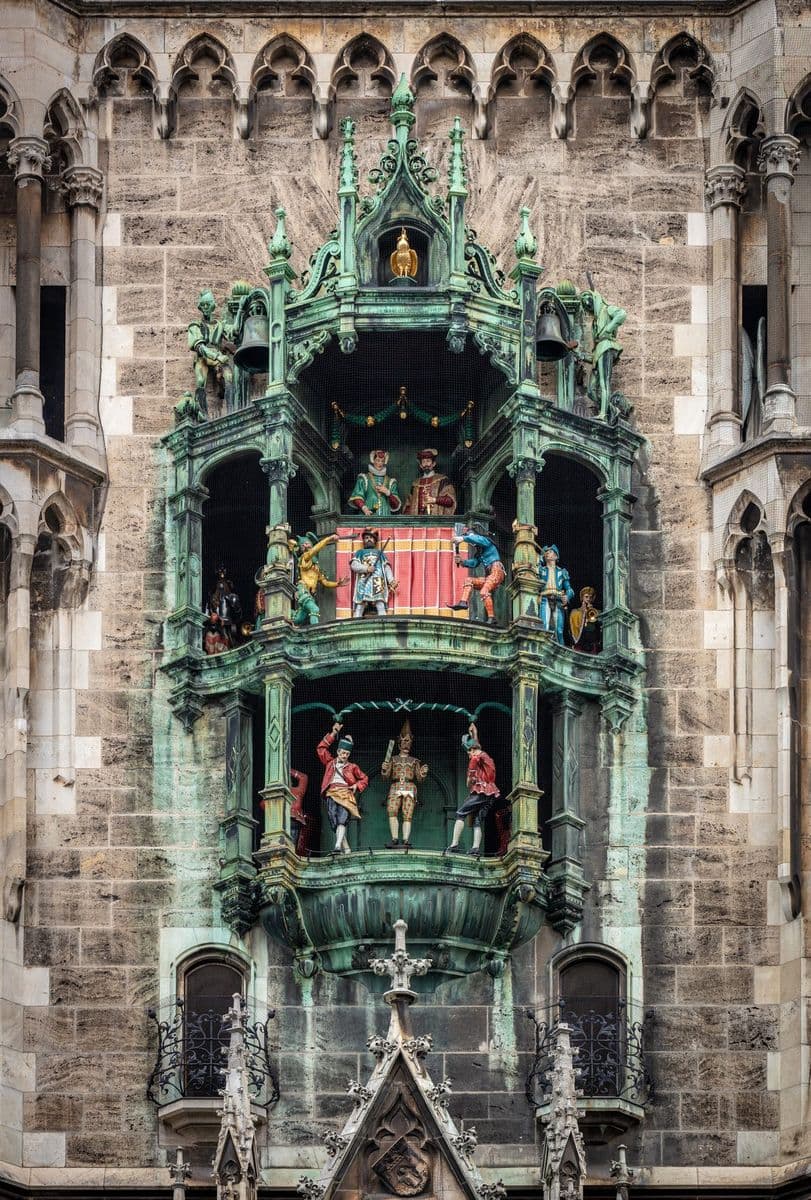
Marienplatz. The central square, with the neo-Gothic New Town Hall filling one side. The Glockenspiel figures turn at 11:00 and 12:00, and at 17:00 in summer. Free, about 40 minutes.
Alter Peter. The tower of St Peter's, Munich's oldest parish church, right behind Marienplatz. The climb is about 300 steps with no lift; the reward is a straight view down onto the Glockenspiel and the Frauenkirche, and the Alps on a clear day. With the Olympiaturm closed, this is the best proper view in the centre. About 45 minutes.
Frauenkirche. The brick cathedral whose two domed towers still define the skyline. Free to enter, and the "Devil's Footprint" in the entrance floor comes with a good story. The south tower is open for climbing, with tickets sold on site only. About 35 minutes.
Viktualienmarkt. The permanent food market just off Marienplatz: cheese, game, honey, flowers, and a beer garden in the middle where you may bring your own food and only buy the drinks. Closed Sundays. About an hour.
Asamkirche. A tiny late-baroque church squeezed between two houses, decorated by the Asam brothers to the point of delirium. Free, fifteen minutes, and memorable.
Munich Residenz. The Wittelsbach palace in the middle of the city: 130 rooms, the Antiquarium hall and a treasury of crowns and reliquaries. Far less visited than it deserves. Museum and Treasury are separate tickets, with a combined one available; the Hofgarten outside is free. Book ahead, about 2 hours.
Hofbräuhaus. The most famous beer hall in the world: a brass band, litre steins, 3,000 seats. Worth an hour once, for the spectacle; Munich's better beer is usually drunk outdoors.
The Kunstareal: world-class museums, and a €1 Sunday
North of the old town, the Kunstareal holds a concentration of museums most cities would build a whole trip around. On Sundays, the state museums here charge €1.
Alte Pinakothek. One of the great old-master collections in Europe - Dürer, Rubens, Rembrandt, Leonardo - and, while the Neue Pinakothek is closed, also its key 19th-century works. Reliably quiet. Closed Mondays, about 1 hour 50 minutes.
Pinakothek der Moderne. Four collections in one building: modern art, design, graphics and architecture, including a basement of cars and industrial design that people wander into and stay in. Closed Mondays, open until 20:00 on Thursdays. About 1 hour 40 minutes.
NS-Dokumentationszentrum. Built on the site of the Nazi Party headquarters, it documents Munich's role as the movement's birthplace with unflinching directness. Free entry, closed Mondays, about 1 hour 50 minutes - and, in MEVAYA's view, the most important museum in the city.
The Englischer Garten, the Eisbach and Schwabing
The Englischer Garten is larger than Central Park, with a stream you can float down, meadows people genuinely sunbathe in, and beer gardens scattered through it. It's free, has no gate and no closing day, and is plausibly the single best thing about living in Munich. Plan about 1.5 hours for a first walk, more if you stop.
At its southern edge, the Eisbach has a standing wave where surfers queue on the bank and ride one at a time, year-round, in wetsuits. Free, unlikely and a genuinely great twenty minutes.
Inside the park, three beer gardens serve three different moods. The Chinesischer Turm, around a wooden pagoda with a brass band, is the classic: the atmosphere is the draw, the food is functional. The Hirschau is where locals go to avoid it, with a playground alongside. The Aumeister, at the far northern end, is the reward after a long walk or bike ride. West of the park, Schwabing, the old bohemian quarter, has bookshops, pavement cafés and the Elisabethmarkt, a small neighbourhood market with none of the tourists.
Olympiapark and BMW
The 1972 Olympic site, with its tent-like roof and a hill built from wartime rubble, is free to walk and has a lake below the hill. BMW Welt next door is a free showroom of architectural swagger; the BMW Museum beside it is ticketed and covers the company's whole history. The two pair naturally, and together with the park they make a relaxed half-day that works especially well with children.
Nymphenburg Palace
The Wittelsbach summer palace out west, with a park of canals, follies and swans that is free to walk. Inside, the Gallery of Beauties is exactly what it sounds like, and rather good. Plan about 2 hours 10 minutes; the palace is ticketed and best booked ahead, the park is free year-round.
The Isar and the neighbourhoods
The Isar, renaturalised as it runs through the city, has gravel beaches, weirs and barbecue spots, and on summer evenings Munich moves down to it. South of the centre, the Glockenbachviertel - independent shops, record stores, cafés, the heart of the city's LGBTQ+ scene - is where Munich looks least like a postcard and most like itself. The Westpark, with Thai, Japanese and Chinese gardens and a summer open-air cinema, is almost entirely local.
Munich with children
The Deutsches Museum is still the strongest single option, even half-open: a real U-boat cut open, mining tunnels under the building, aircraft hanging from the ceiling. Book ahead and plan about 2.5 hours. The Olympiapark with BMW Welt, the playground by the Hirschau beer garden, the Isar beaches in summer, and the Spielzeugmuseum - a historic toy collection across four floors of the old town-hall tower on Marienplatz, with no lift - fill the rest.
Sundays in Munich
Sunday is quiet here. Most shops close, including the Kaufingerstraße shopping axis, and the Viktualienmarkt and Elisabethmarkt don't trade. In exchange, the Pinakotheken cost €1, the parks and the Isar are at their best, and the beer gardens are full. A Sunday is the natural day for the Kunstareal and the Englischer Garten, in that order.
Turning this into an actual day
This page shows what Munich holds; it doesn't order it. MEVAYA's Munich in One Day and Munich in Two Days guides show what the planner does with these stops - real arrival times, real visit durations, and a route that knows which sights are closed in 2026 before you get to the door.
Quick questions
What are the best things to do in Munich for a first-time visitor?
For most first trips: Marienplatz, the Frauenkirche and the Viktualienmarkt in the old town, the view from Alter Peter, one museum in the Kunstareal, the Englischer Garten with the Eisbach surfers and a beer garden, and either the Olympiapark or Nymphenburg Palace.
Is the Olympiaturm open in 2026?
No. The Olympiaturm has been fully closed for renovation since June 2024, with reopening expected in early 2027. The free Olympiaberg hill beside it and the Alter Peter tower in the city centre are the best alternatives for a view.
Is the Deutsches Museum worth visiting during the renovation?
Yes, though with adjusted expectations. Only one half of the museum is currently open, with the second half expected by 2028, and some classic exhibits are not on display. It is still one of the largest science museums in the world and the best option in Munich for children.
What can you do in Munich on a Sunday?
The Pinakotheken museums cost €1 on Sundays, and the Englischer Garten, the Isar and the beer gardens are at their best. Most shops, the Viktualienmarkt and the Elisabethmarkt are closed, so Sunday isn't a shopping day.