
Prague's famous sights line up along a single walk, from Old Town Square over Charles Bridge to the Castle. That line is why first visits feel crowded. The rest of the city is where the room is.
- The classic line
- Old Town Square, Charles Bridge, Malá Strana, Prague Castle - one long walk, mostly uphill
- Closed on Saturdays
- The Jewish Quarter (Josefov) - and on Jewish holidays
- Book ahead
- Prague Castle circuit, the Jewish Quarter, the Municipal House (guided tours)
- Realistic pace
- 3 to 4 substantial stops a day; the Castle circuit alone takes almost 2 hours
The most famous things to do in Prague line up along one walk: Old Town Square, then Charles Bridge across the Vltava, then the lanes of Malá Strana, then up the hill to Prague Castle. It's a superb walk, and it's the reason so many first visits feel crowded - almost everyone does the same line, in the same direction, at the same time of day.
The good news is that Prague is much more than that line. Across the river and on the hills around it are viewpoints that beat the Castle's, a second castle almost nobody visits, some of the best Art Nouveau in Europe, and residential neighbourhoods with independent shops, beer gardens and very few visitors.
Everything below comes from MEVAYA's curated Prague data, the same stops, visit durations and booking rules the planner builds routes from. A realistic day holds 3 to 4 substantial stops. Prague is compact but hilly; the map underestimates the Castle, and your legs will correct it.
The classic line, and the order that works
Old Town Square. Gothic spires, baroque façades and the astronomical clock on the town hall - a working medieval instrument that tracks the sun, the moon and the zodiac. Free and open at every hour. About 40 minutes.
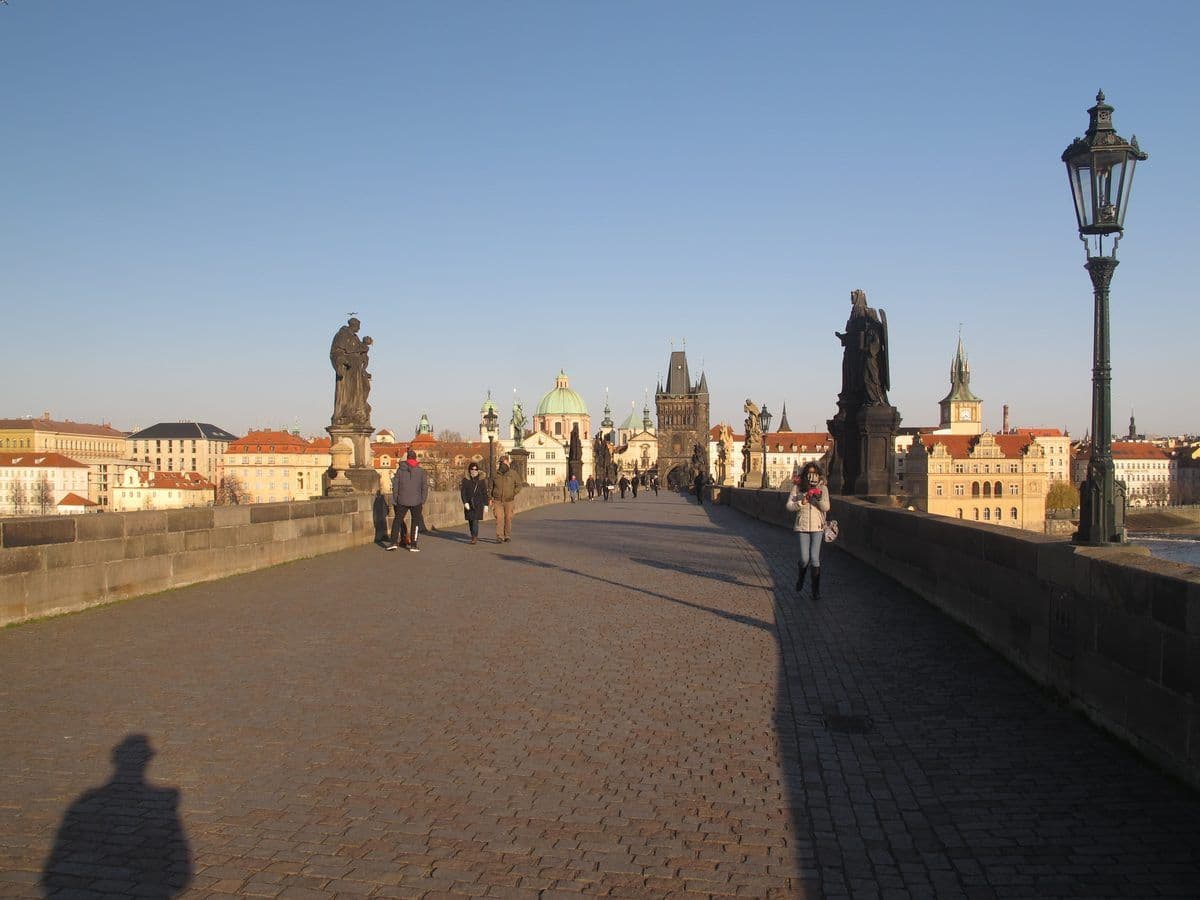
Charles Bridge. Six hundred years old, thirty baroque statues, and the Castle rising at the far end. Free, always open, and a completely different experience depending on when you cross: early morning and late evening it's a bridge; from late morning it's a queue with a view. About 40 minutes.
Malá Strana and Kampa Island. Below the Castle on the far bank, Malá Strana's baroque lanes lead to Kampa, a small island under Charles Bridge with a mill wheel, a park along the water and the John Lennon wall around the corner. Two minutes off the bridge and a fraction of the people. Free, about 45 minutes.
Prague Castle. The largest ancient castle complex in the world, and still the seat of the Czech president. The courtyards and grounds are free and open from 06:00 to 22:00; St Vitus Cathedral, the Old Royal Palace and Golden Lane sit inside a ticketed circuit open 09:00 to 17:00 from April to October and until 16:00 in winter. Book ahead, and plan about 1 hour 50 minutes.
St Vitus Cathedral. Six hundred years in the building, with an Alfons Mucha stained-glass window that justifies the visit on its own. A small area at the back is free; the main nave needs the Castle ticket. Services often shorten its hours, so check the same week. About 50 minutes.
Strahov Monastery Library. Two baroque halls, painted end to end, with globes and cabinets of curiosities - viewed from the doorway, which is the one catch. A short walk above the Castle, and a natural last stop before heading down. About an hour.
The order matters more than the list. Most people walk the line uphill from the Old Town in the early afternoon, which is the most crowded and most tiring way to do it. Crossing the bridge early, doing the Castle in the morning and coming down through Malá Strana after lunch is the same walk with far less friction.
The Jewish Quarter: plan around Saturday
Josefov holds six synagogues and the Old Jewish Cemetery, where twelve thousand headstones lean against each other because burials were stacked twelve deep. The Pinkas Synagogue carries the names of 78,000 Czech Holocaust victims on its walls. It's one of the most important places in Prague, and it closes on Saturdays and on Jewish holidays. Some buildings on the route, including the Klausen Synagogue and the Ceremonial Hall, are temporarily closed for renovation, so confirm which are open before buying a combined ticket. Book ahead, and allow almost 2 hours.
Views, from free to barely paid
Prague is a city of viewpoints, and the best ones are not where most visitors stand.
Petřín Hill, above Malá Strana, has a small Eiffel-shaped lookout tower, a mirror maze and rose gardens, and the best view in Prague with the shortest queue. The funicular that normally carries you up has been out of service since 2024 for reconstruction; check whether it has reopened, otherwise plan a 30 to 45 minute uphill walk or a tram to Pohořelec. About 1.5 hours.
Letná Park, on a plateau across the river from the Old Town, gives the best panorama of the bridges in the city, with a big beer garden under the trees at its edge. Riegrovy sady, a sloping park in Vinohrady, looks straight at the Castle silhouette at sunset. The ramparts of Vyšehrad give one of the two best sunsets in Prague. All three are free.
The Kunsthalle Praha, a former electrical substation turned contemporary art space, has a rooftop café looking straight across at the Castle. You can go up without a museum ticket, and almost nobody does.
Vyšehrad: the other castle
South of the centre, Vyšehrad is a hilltop fortress with a neo-Gothic basilica, ramparts you can walk, and the cemetery where Dvořák and Mucha are buried. It's free, green and used mostly by locals - the Prague Castle experience without the Prague Castle crowd, if you're willing to trade palaces for lawns. About 80 minutes.
Art Nouveau and the 20th century
The Municipal House (Obecní dům) is Prague's most lavish Art Nouveau building, decorated in 1912 by the leading Czech artists of the day, including Mucha, who designed the Mayor's Hall alone. Czechoslovak independence was declared here in 1918. The interior is visitable on guided tours only; book one. About an hour.
The Mucha Museum tells the story of the posters that defined a visual era, and of how the artist came to resent being known for them. About an hour.
For the 20th century, Wenceslas Square - really a 750-metre boulevard - is where Czech history kept happening, in 1918, 1968 and 1989. Frank Gehry's Dancing House leans into its neighbour on the riverbank; it works best from the outside, and the outside is free. The Trade Fair Palace, a functionalist 1920s building holding the National Gallery's modern collection, including a Picasso and Klimt room, is superb and reliably almost empty (closed Mondays, about 1 hour 50 minutes).
Where Prague lives: Vinohrady, Karlín and the markets
Vinohrady, ten minutes from the Old Town, has tree-lined streets of independent shops, bookshops, delis and cafés - the residential Prague visitors are surprised to find so close. Karlín, rebuilt after the 2002 floods, is the city's design and food quarter, with concept stores, roasteries and bakeries, and almost no visitors. Back in the Old Town, the Havelská Market has run since 1232; the souvenir end is what it is, but the produce end is still real.
Czech beer culture is worth a mention of its own. Beer Point lets you pour from fourteen taps yourself, paying by the millilitre, which makes tasting Czech craft beer cheap and unembarrassing. The Beer Spot, just below Petřín, is the obvious stop on the way down from the hill.
Prague with children
Prague Zoo, consistently ranked among the world's best, spreads across a hillside in Troja with an Africa House, an Indonesian jungle hall, a chairlift and a children's zoo with a petting area. It's a half-day - allow about 3 hours. Petřín, with its mirror maze and lookout tower, works well for older children, and Stromovka, the old royal hunting park, is the easiest park in the city with a pushchair.
Turning this into an actual day
This page shows what Prague holds; it doesn't sequence it. MEVAYA's Prague in One Day and Prague in Two Days guides show what the planner does with these stops - real arrival times, real visit durations, and the classic line walked in the direction that saves both time and knees.
Quick questions
What are the best things to do in Prague for a first-time visitor?
For most first trips: Old Town Square and the astronomical clock, Charles Bridge, Malá Strana and Kampa, Prague Castle with St Vitus Cathedral, the Jewish Quarter (not on a Saturday), and one of the viewpoints: Petřín, Letná or Vyšehrad. That is two to three days at a realistic pace.
What is the best time to visit Charles Bridge?
Early morning or late evening. The bridge is free and always open, but from late morning onwards it fills with visitors and street stalls. Crossing it early, before a morning at the Castle, avoids most of the crowd.
What can you see for free at Prague Castle?
The courtyards and grounds are free and open daily from 06:00 to 22:00, and a small area at the back of St Vitus Cathedral is free. The main nave of the cathedral, the Old Royal Palace and Golden Lane require the Castle circuit ticket.
Is the Jewish Quarter in Prague open on Saturdays?
No. The Jewish Quarter's synagogues and the Old Jewish Cemetery close on Saturdays and on Jewish holidays. Some buildings on the route are also temporarily closed for renovation, so check which are open before buying a combined ticket.